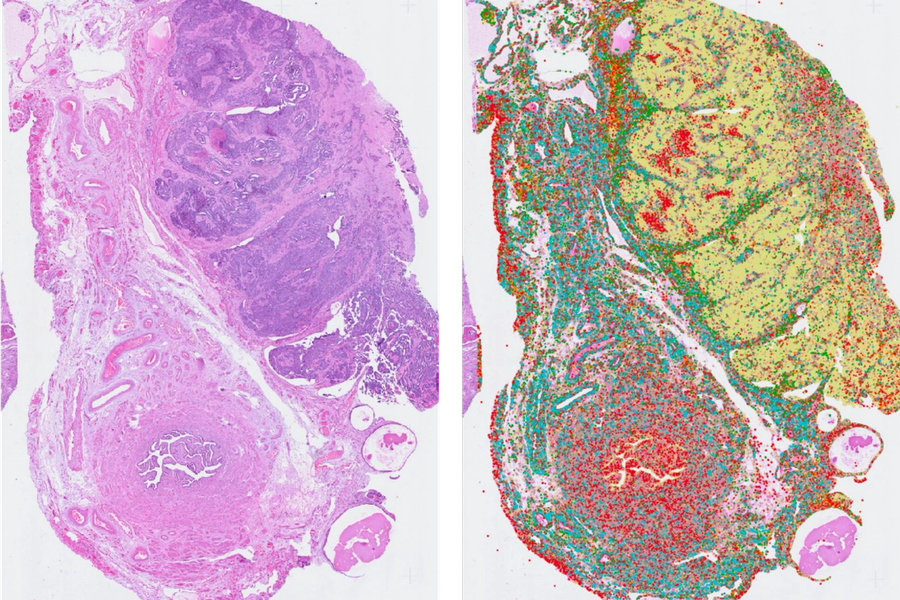


In digital pathology, the hype of the moment is the virtual generation of extra information from H&E. Can we bypass IHC staining, spatial proteomics or transcriptomics, and generate the data directly from an algorithm? And where would that fit into a clinical protocol?
The reasoning is straightforward: £10,000 for a complete test, £10 for an AI run. It's an argument that makes anyone want to jump on the opportunity.
Is it working at all?
Let's take the example of gene expression prediction. Here, the simple answer is yes and no. For some genes, some of the time, yes. For others, no. Prediction only works where the expression leaves a morphological trace. And it predicates itself on strong quality control, large datasets, multiple institutions and coherent cohorts. Even under those conditions, results are limited, with an average Pearson correlation of 0.2–0.3 (DeepSpot), and industry not far above. But average Pearson correlation is an aggregate metric: it hides the fact that prediction may work well for some genes. And that may be helpful.
Two limitations sit underneath. First, these models inherit their training data. A foundation model picks up representations specific to one hospital's staining protocol or one vendor's assay, and with only a handful of spatial-omics providers in the world, that's a narrow base. How well would these models transfer to other hospitals, where the staining protocol is different? And, most importantly, how do we trust it? Second, out-of-distribution error. Even a model that performs perfectly on its validation data may respond completely differently to data it has never seen. And if we can't see the error, can we trust the output?
With other systems, such as flow cytometry or methylation arrays, there's a mechanistic traceability that we can trust. Here, we rely on the model behaving as it did in training.
Why not go straight from H&E to the endpoint?
We might ask why we bother training a model to predict gene expression or protein abundance when the real goal is a downstream clinical endpoint. Why not learn H&E → endpoint directly?
The key is to separate training from inference. At inference, we often do go straight from H&E to the endpoint; no omics data are needed. But during training, omics supervision can make the H&E encoder better. Models trained with omics supervision often outperform plain H&E models on downstream tasks. This seems paradoxical, but it isn't: the omics head is not a required middle step. It is an auxiliary task. It provides dense, biologically grounded targets that steer the model towards representations more aligned with the underlying biology. A plain H&E → endpoint model can learn similar representations, but endpoint labels are usually sparser, noisier and more prone to shortcut learning, so it needs much more data. Omics supervision is simply a better teacher.
Think of losing my glasses, which happens often: it is easier to find them if I know they are somewhere on my desk than if they are somewhere in town. The desk is not the goal; it narrows the search. Likewise, omics prediction is not the endpoint; it narrows the space of representations.
Can we even regulate it?
The evident next question is, could these models be regulated for use as a companion diagnostic (CDx), or directly to inform treatment in a hospital? In my opinion, and by a strict reading of the regulators' definitions, yes. Nothing stops a company from proposing a well-defined intended use, validating predictions against the real assay on a multi-site cohort, and taking that dossier to the MHRA or the FDA. That company would probably limit the claim to the handful of genes that can be predicted well. I'm not an expert here, but I don't see an obvious obstacle. Still, personally, I would prefer a mechanistic link between the gene and the morphological trace it leaves.
What are the potential use cases?
Personally, I don't see virtual omics models being readily used for late-stage clinical trials or regulated decisions. Perhaps it's a lack of imagination, but I can't picture a treatment decision made without mechanistic evidence. It seems a bit cowboy.
That doesn't mean they aren't useful. I see two places where they can genuinely shine. The first is as a teacher. Spatial transcriptomics can train better H&E models, and it's those models, not the virtual omics itself, that might eventually reach the clinic. The second is hypothesis generation, especially in retrospective studies. Archived slides from past clinical trials can be retrieved, analysed for predicted gene expression, and mined for new biomarker hypotheses, all with no impact on patients. Any promising signal can then be confirmed with the real assay before it goes anywhere near a treatment decision. Neither of these is the full replacement for other techniques that the hype promised, but they are progress.
So, El Dorado or fool's gold?
Neither. I don't think it's the promised land that replaces every other assay, and it isn't worthless either. It's closer to silver: less glamorous than the pitch, but real, and with a genuine place in how we work.