
Nemo Ki67
Ki67 scoring on IHC
Ki67 scoring on IHC: percentage of positive tumour nuclei, global and in the hotspot.
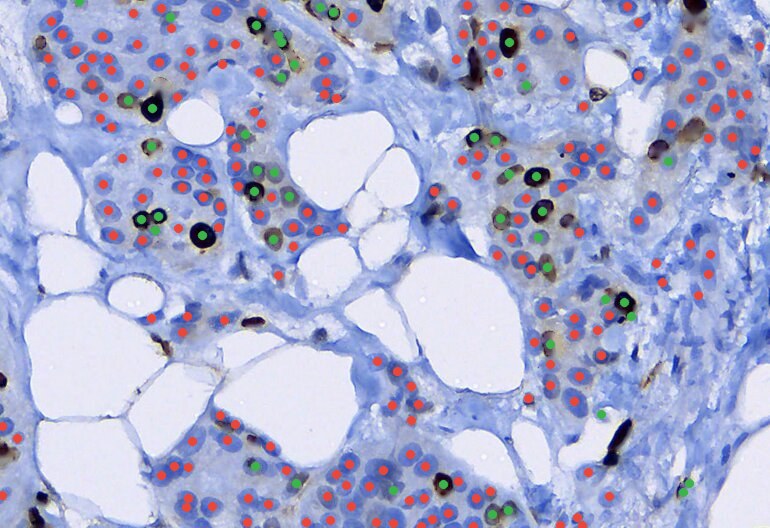
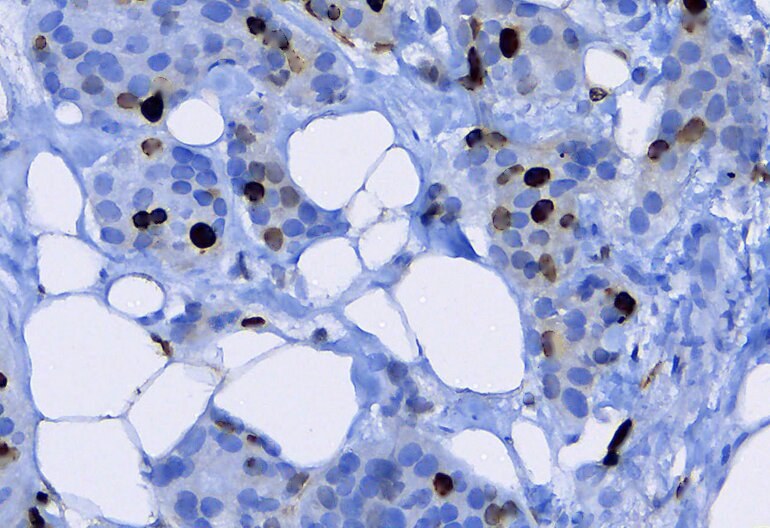
Ki67 varies between laboratories.
Percentages vary widely between laboratories and readers, and the cut-offs used to grade or stratify (14 %, 20 %, 30 %) sit inside that variability.
Grade and stratification depend on the index. In breast and neuroendocrine tumours, Ki67 helps set grade and treatment. A counted index with its region is a reproducible one.
Three things you stop doing by hand
- 01Every tumour nucleus
Every tumour nucleus classified positive or negative for Ki67.
- 02Comparable across labs
Same index for the same slide; hotspot chosen by the model and shown.
- 03Global and hotspot
Global and hotspot indices, both reported with the count behind them.
Global · every tumour nucleusHotspot · densest areaTwo ways to read Ki67
The global index averages the whole tumour; the hotspot index takes the densest area. Nemo Ki67 reports both, so the report follows whichever method your guideline asks for.
Used in breast cancer adjuvant decisions and neuroendocrine tumour grading.
What you get back
Output | What you get | Format |
|---|---|---|
| Ki67 index | % positive tumour nuclei, global | data |
| Hotspot index | % in the densest region, region outlined | data + overlay |
| Nucleus map | positive and negative tumour nuclei | overlay |
| Per-cell export | coordinates and class | CSV / JSON |
Ki67 index scored following the International Ki67 in Breast Cancer Working Group recommendations · Reference →
Validation pilot
Epithelial cell detection in the tumour region.
98.7% of detections are tumour cells
Each dot is one cell, from the reported precision and recall. Pilot result.
Try Nemo Ki67
Run it on a slide in the platform, or ask for the product sheet with the full output specification.